← Back to document 506
AI review — page 5
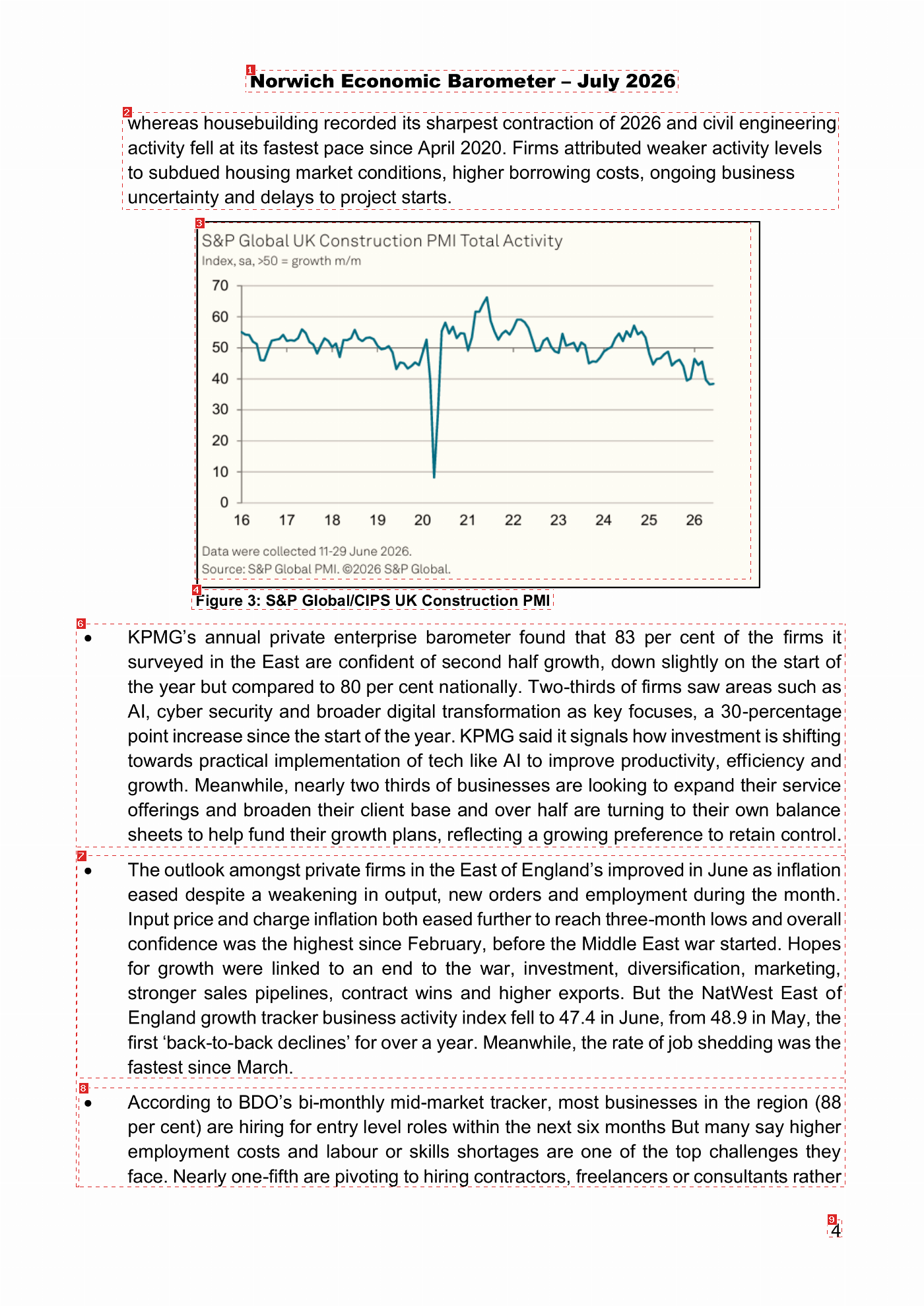
claude-opus-4-8 · prompt v7 · 2026-09-04T15:09:24+00:00 · applied: yes · changed: yes
Screenshot sent to the model (reading-order tags burned on)
Instructions (system prompt)
The screenshot has annotations burned onto it that are NOT part of the document:
- a small red numbered tag at the top-left corner of each item, showing that item's position in the OCR-determined reading order (the same order the items appear in the json data);
- a red-and-white dotted outline around each item, showing the area the OCR detected for that content block.
Use the tags and outlines to see the detected reading order and item boundaries directly on the page, and judge that sequence against how a human would naturally read it. Ignore the annotations when checking text fidelity — they overlay the content, they are not content.

For the given screenshot of a PDF's page and the attached json data, I want you to perform the following tasks in order...

Review the reading order set out in the json data and compare to what a natural reading order for that of a human would be by looking at the screenshot. Decide on any changes and re-arrange the items for the most logical reading order.
Look at all text for each item and correct any extraction errors like missing words, spelling mistakes etc.
Look at each item in the JSON and ensure that the OCR process has identified the item as the correct type: text, list item etc.
Look for any text that duplicates: if two items next to each other contain the exact same text but the text only appears once on the screenshot, one of them is an extraction error — keep the item whose box matches where the text is visible and flag the other for removal.
Make amendments as you proceed through the items and list of instructions.
Reading Order Advice: If there is columns with headings and text, I wouldnt expect the reading order to jump from one heading straight to another if there is text associated with that heading.

Return format: Give me the json data back only, with the amendments you make.

Mechanical notes (so your answer can be applied automatically):
- Each item has an `id` — keep every item and its `id` exactly as given; never invent, drop or duplicate ids. Re-arranging means changing the position of items (and their nesting) in the arrays.
- Never move text (or a type) from one item to another: each item's coordinates travel with its id, so to change reading order you must move the whole item object, and text amendments must be in-place corrections of that item's own text.
- To flag a duplicate item, keep it in the array and add `"remove": "duplicate"` to it — never just delete it (deleted items are restored automatically).
- ids are opaque labels, not sequence numbers: never renumber them. After a removal or re-arrangement, every remaining item keeps the exact id it came with, even if the ids no longer look sequential.
- Text may contain `[pN.M…]` placeholders marking where an inline formula belongs — treat them as part of the text and leave them exactly where they are.
- `box` is [left, top, right, bottom] as percentages of the page from the top-left corner; return it unchanged.
- Respond with raw JSON only: no code fences, no commentary, same shape as the input (`{"items": [...]}`).
User message (json data sent)
Page 5 json data:

{"items":[{"id":"p5.1","type":"heading","box":[27,5,73,7],"text":"Norwich Economic Barometer – July 2026"},{"id":"p5.2","type":"text","box":[13,9,91,16],"text":"whereas housebuilding recorded its sharpest contraction of 2026 and civil engineering activity fell at its fastest pace since April 2020. Firms attributed weaker activity levels to subdued housing market conditions, higher borrowing costs, ongoing business uncertainty and delays to project starts."},{"id":"p5.3","type":"figure","box":[21,17,81,44],"text":""},{"id":"p5.4","type":"caption","box":[21,45,60,47],"text":"Figure 3: S&P Global/CIPS UK Construction PMI"},{"id":"p5.5","type":"list","box":[8,48,91,91],"text":"","children":[{"id":"p5.5.1","type":"list_item","box":[8,48,91,65],"text":"KPMG's annual private enterprise barometer found that 83 per cent of the firms it surveyed in the East are confident of second half growth, down slightly on the start of the year but compared to 80 per cent nationally. Two-thirds of firms saw areas such as AI, cyber security and broader digital transformation as key focuses, a 30-percentage point increase since the start of the year. KPMG said it signals how investment is shifting towards practical implementation of tech like AI to improve productivity, efficiency and growth. Meanwhile, nearly two thirds of businesses are looking to expand their service offerings and broaden their client base and over half are turning to their own balance sheets to help fund their growth plans, reflecting a growing preference to retain control."},{"id":"p5.5.2","type":"list_item","box":[8,66,91,83],"text":"The outlook amongst private firms in the East of England's improved in June as inflation eased despite a weakening in output, new orders and employment during the month. Input price and charge inflation both eased further to reach three-month lows and overall confidence was the highest since February, before the Middle East war started. Hopes for growth were linked to an end to the war, investment, diversification, marketing, stronger sales pipelines, contract wins and higher exports. But the NatWest East of England growth tracker business activity index fell to 47.4 in June, from 48.9 in May, the first 'back-to-back declines' for over a year. Meanwhile, the rate of job shedding was the fastest since March."},{"id":"p5.5.3","type":"list_item","box":[9,83,91,91],"text":"According to BDO's bi-monthly mid-market tracker, most businesses in the region (88 per cent) are hiring for entry level roles within the next six months But many say higher employment costs and labour or skills shortages are one of the top challenges they face. Nearly one-fifth are pivoting to hiring contractors, freelancers or consultants rather"}]},{"id":"p5.6","type":"footer","box":[90,93,91,95],"text":"4"}]}
Model response
{"items":[{"id":"p5.1","type":"heading","box":[27,5,73,7],"text":"Norwich Economic Barometer – July 2026"},{"id":"p5.2","type":"text","box":[13,9,91,16],"text":"whereas housebuilding recorded its sharpest contraction of 2026 and civil engineering activity fell at its fastest pace since April 2020. Firms attributed weaker activity levels to subdued housing market conditions, higher borrowing costs, ongoing business uncertainty and delays to project starts."},{"id":"p5.3","type":"figure","box":[21,17,81,44],"text":""},{"id":"p5.4","type":"caption","box":[21,45,60,47],"text":"Figure 3: S&P Global/CIPS UK Construction PMI"},{"id":"p5.5","type":"list","box":[8,48,91,91],"text":"","children":[{"id":"p5.5.1","type":"list_item","box":[8,48,91,65],"text":"KPMG's annual private enterprise barometer found that 83 per cent of the firms it surveyed in the East are confident of second half growth, down slightly on the start of the year but compared to 80 per cent nationally. Two-thirds of firms saw areas such as AI, cyber security and broader digital transformation as key focuses, a 30-percentage point increase since the start of the year. KPMG said it signals how investment is shifting towards practical implementation of tech like AI to improve productivity, efficiency and growth. Meanwhile, nearly two thirds of businesses are looking to expand their service offerings and broaden their client base and over half are turning to their own balance sheets to help fund their growth plans, reflecting a growing preference to retain control."},{"id":"p5.5.2","type":"list_item","box":[8,66,91,83],"text":"The outlook amongst private firms in the East of England's improved in June as inflation eased despite a weakening in output, new orders and employment during the month. Input price and charge inflation both eased further to reach three-month lows and overall confidence was the highest since February, before the Middle East war started. Hopes for growth were linked to an end to the war, investment, diversification, marketing, stronger sales pipelines, contract wins and higher exports. But the NatWest East of England growth tracker business activity index fell to 47.4 in June, from 48.9 in May, the first 'back-to-back declines' for over a year. Meanwhile, the rate of job shedding was the fastest since March."},{"id":"p5.5.3","type":"list_item","box":[9,83,91,91],"text":"According to BDO's bi-monthly mid-market tracker, most businesses in the region (88 per cent) are hiring for entry level roles within the next six months But many say higher employment costs and labour or skills shortages are one of the top challenges they face. Nearly one-fifth are pivoting to hiring contractors, freelancers or consultants rather"}]},{"id":"p5.6","type":"footer","box":[90,93,91,95],"text":"4"}]}